
From Pre-SDE
to SDE to EBITDA:
Where the Rajang
Economy Gets Built.
We find businesses before the numbers are clean, acquire them at SDE multiples, and convert them into auditable, owner-independent EBITDA assets. That three-stage journey is the entire mandate.
Pre-SDE → SDE → EBITDA:
The Three Stages of Value
Most micro-SMEs in this corridor sit at Pre-SDE — cash is real but the numbers are informal, owner-tangled, and unauditable. Our mandate starts there and ends at institutional EBITDA.
We source businesses before they are packaged for sale — cash-flowing operations where the owner has never separated personal spending from business profit, and where no broker has yet arrived. This is where the real entry advantage is found.
- Owner-operated, 3+ year operating history
- Revenue real, but financials informal and owner-tangled
- No formal SDE or EBITDA calculation — priced on feel
- Sourced through relationships, not brokers or listings
We acquire at SDE multiples — the valuation language of owner-operated businesses. At this stage, the business is still a job: the owner is the operations. That is by design. Buying a job at job prices is the entry point for the conversion that follows.
- Structured LOI and due diligence on SDE basis
- Seller financing covering the majority of consideration
- Transition window with founder advisory arrangement
- Baseline financial reporting initiated immediately at close
SDE is what the owner takes home. EBITDA is what the market will pay for. We build EBITDA by formalizing supplier accounts, eliminating unrecorded cash, standardizing pricing, and installing a management layer that removes the owner from operations entirely.
- Owner-independent: management-run, not founder-run
- Auditable financials: monthly P&L, cash flow, EBITDA statement
- EBITDA growth from cost and efficiency gains — not revenue assumptions
- Eligible for trade sale, secondary buyout, or long-term hold
At Pre-SDE, the business has cash flows but no clean numbers. At SDE, we have a valuation basis — but we're still buying a job. The mandate is the journey from there to EBITDA: formalizing supplier accounts to lower costs, standardizing pricing to capture margin, eliminating unrecorded cash transactions, and installing the management layer that makes the business owner-independent. The result: the price we paid at SDE entry feels like 2× within 12–18 months — not because the valuation changed, but because the earnings expanded.
SDE is what the owner takes home. EBITDA is what the market will pay for. The gap between them is where we work.
(SDE-based)
(Post-EBITDA Growth)
(Institutional EBITDA)
The multiples shown (3.5×, ~2×, 5–7×) are illustrative scenarios based on our operational methodology. They do not represent guaranteed, projected, or historical returns for any specific investment. Actual outcomes will vary materially. This information is directed solely at Sophisticated Investors under CMSA 2007 Schedules 6 & 7 and does not constitute an offer of securities or financial advice.
Currently evaluating three businesses across the corridor
We are presently in active evaluation across food & beverage and wholesale distribution — sectors with deep community roots, long operating histories, and real, recurring cash flows. Deal details are shared exclusively with attested partners following a direct private introduction.
under evaluation
primary sector focus
in operation
Full mandate details — financials, deal structure, and co-investment terms — are available to verified partners only, shared directly and privately after an initial conversation.
Request a Private Introduction →Pre-SDE to SDE.
SDE to EBITDA.
regional focus
The full journey: Pre-SDE, SDE, and EBITDA
Eastern Rajang Capital finds businesses before the numbers are clean, acquires them at SDE multiples, and builds them into auditable, owner-independent EBITDA assets — in the Rajang corridor of Sarawak, where no institutional firm is looking.
We specialize in businesses generating RM150,000 to RM300,000 in annual SDE at entry — what the owner takes home. With a manager in place, that becomes RM100,000 to RM200,000 of EBITDA. That is a deliberate choice. At this level, competition from institutional buyers is negligible, entry valuations reflect a job — not an asset — and the conversion to EBITDA creates compounding, measurable value.
Read more about us →
The three-stage
value journey.
Every acquisition we make starts at Pre-SDE — informal, owner-tangled, undervalued. We price it at SDE, acquire it at a job multiple, and convert it into EBITDA. That is the entire thesis, applied to a single well-defined corridor where institutional capital is absent.
Across the Rajang corridor, a generation of founder-operators is approaching the end of their working lives with no natural successor and no formal books. These businesses are priced on SDE — what the owner takes home — because that is the only number that exists.
We arrive before the broker does. We acquire at SDE multiples — 2.0×–3.5× — with seller-financed structures that reflect the job-like nature of the business at entry. The EBITDA conversion is the work that follows.
SDE is what the owner takes home. EBITDA is what the market will pay for. The gap between them — owner add-backs, informal cash, undocumented supplier terms, key-person dependency — is where our operational work creates value that no financial engineering can replicate.
We build EBITDA by installing systems, formalizing accounts, documenting processes, and replacing owner dependency with a management layer. These changes alone — without heroic growth assumptions — expand earnings and unlock institutional exit valuations.
Pre-SDE to SDE
to EBITDA.
We originate before the numbers exist, acquire when the business is still a job, and build until it is an asset. Each stage demands a different discipline — and we apply all three.
We find businesses before they are packaged for sale — directly, through local relationships, off-market. At this stage, the cash is real but the numbers are informal. That is the point. We price what we find, not what a broker presents.
We acquire at SDE multiples — 2.0×–3.5× — using seller-financed structures that align incentives with the founder. At entry, the business is owner-dependent by design. We buy a job at job prices. The conversion starts the day we close.
Immediately post-acquisition, we retain staff, maintain client relationships, and ensure the business operates without disruption. We do not restructure before we understand. The baseline financial reporting we initiate here becomes the foundation for everything that follows.
We install POS systems to capture unrecorded cash, formalize supplier accounts to improve margin structure, document processes to transfer founder knowledge, and install a management layer to remove owner dependency. SDE becomes EBITDA. The job becomes an asset.
Businesses with durable demand
We focus on sectors with recurring or predictable revenue, loyal customer bases, and straightforward operations. Complexity is a risk at this scale. We prefer businesses that are simple, essential, and defensible.
Maintenance contracts, facilities management, and essential services with recurring, predictable income streams.
Accounting, secretarial, training, and specialist advisory practices with established client relationships.
Community-rooted FMCG, food businesses, and retail operators serving consistent, captive demand along the corridor.
The Rajang corridor advantage
Formal capital has little presence in this corridor. That gap is precisely where patient, informed investors have the most durable advantage.
The Rajang River is Malaysia's longest inland trade route. Infrastructure development and port expansion position the region for long-term growth.
Most industries in this corridor are served by small, independent operators. Disciplined roll-up and partnership strategies can create outsized value.
Our on-the-ground presence and community relationships provide access to information that remote investors simply cannot obtain.
Built for those who understand the gap
Pre-qualified strategic partners participate alongside our own capital on a deal-by-deal basis. You see the acquisition at SDE, the operational plan, and the projected EBITDA conversion. All enquiries are handled privately and directly via email.
Begin a Conversation →If you have spent years building a business and the cash flow is real but the books are informal — you are exactly who we look for. We offer a structured transition that respects what you built and converts it into something that outlasts you.
Estimate your valuation →Begin a conversation →
We work with accountants, lawyers, brokers, and community intermediaries with visibility into owner-operated businesses at the Pre-SDE or SDE stage. Our mandate is clearly defined — if the books are informal but the cash is real, we want to hear about it.
Submit a Deal →
"SDE is what the owner takes home.
EBITDA is what the market will pay for.
The gap between them is where we work."
We find the job.
We buy the job.
We build the asset.
Eastern Rajang Capital is a private acquisition firm anchored in the Rajang corridor of Sarawak. Our mandate is singular and specific: find businesses at Pre-SDE, acquire them at SDE multiples, and convert them into auditable, owner-independent EBITDA assets. The gap between SDE and EBITDA is where we work — and where value is built.
Eastern Rajang Capital operates as the strategic acquisition brand for Majetika Ventures. All initial Letters of Intent (LOI) and Due Diligence operations are executed by Majetika Ventures as the lead sponsor.
The Rajang corridor
The Rajang River—Malaysia's longest—serves as the primary artery of trade, commerce, and community across interior Sarawak. From Kapit to the coast, it connects a network of towns, communities, and businesses that have sustained the region's real economy for generations.
This corridor is underserved by institutional capital, yet possesses the commercial fundamentals that disciplined investors look for: stable demand, defensible local businesses, fragmented industries, and a population deeply tied to the enterprises that serve them.
We have built deep roots across this corridor. Our presence is not transactional—it is relational, spanning years of community engagement, local enterprise discovery, and earned trust.
SDE is a job.
EBITDA is an asset.
We do not operate as a traditional investment firm. We are operators first. The businesses we acquire are bought as jobs — owner-dependent, informally run, valued on what the founder takes home. We convert them into something the market will pay a multiple for.
That conversion is not financial engineering. It is proximity: to the business, to the people who run it, and to the community it serves. You cannot build EBITDA from a distance. You build it by being there.
We are patient. The Pre-SDE to SDE to EBITDA journey takes 12–24 months done properly. We do not rush it, and we do not cut corners on the operational work that makes it real.
not the other way around
We do not deploy capital into businesses we do not understand deeply. Every investment is preceded by a thorough, context-specific process that respects the complexity of frontier market businesses.
in operational businesses
The operator behind ERC has direct, hands-on experience starting and running businesses in this region — not as a manager, but as the person responsible when things go wrong. That perspective shapes every investment decision made here.
it is a transition of stewardship
When we acquire a legacy business, we become its stewards. We take that responsibility seriously: preserving what was built, and building what comes next.
optional—it is foundational
Businesses in this corridor are woven into their communities. We invest with awareness of that fabric, and we seek to strengthen it rather than disrupt it.

Rajang Corridor, Sarawak
Sarawak-born and corridor-raised — Kanowit, Miri, Kuching, and back again. I grew up moving between towns along this region, which means I understand, better than most, that every part of Sarawak has its own economy, its own rhythm, and its own way of doing things.
(And its own noodles. You cannot get proper Mee Kampua in Miri. I have tried.)
Before Eastern Rajang Capital, I ran businesses the way most people in this corridor do — sole proprietorships, one after another, each one teaching me something the previous one didn't.
People here don't always follow a playbook. They can't. Because business in this corridor runs on human trust before it runs on anything else. No contract replaces a handshake that has history behind it. No system replaces a face that people already know. I learned that by doing it, not by studying it.
From the moment I stepped into the real world I was experimenting. That is just who I am — I try things, I push on them, I see what breaks and what holds. Some worked. Some didn't. All of it was real. And somewhere along the way I started multiple ventures and realised I was asking the wrong question — not "how do I build the next thing" but "what am I actually here to do."
I am still under 30.
That sounds young until you start doing the math. The window before life compounds — before family, before the weight of other responsibilities settles in — is not as wide as it looks from the outside. I can see the gap that needs to be filled. I can see that nobody is moving to fill it. And I am at exactly the age where I have enough experience to act and enough hunger to go all the way.
So that is what I am doing. Not cautiously. Not partially. All the way.
The experiences didn't go to waste. They became the foundation for a mandate that finally felt worth building toward. And this is the moment — before I build my family, before the season changes — where I go all out or I don't go at all.
What drives this mandate isn't a financial model. It's something more personal. The businesses I grew up around — the kedai, the contractor, the supplier everyone in the neighbourhood depended on — most of them are still there. Same owner. Same operation. No succession plan. No one coming after.
My belief is simple: when a group of these businesses share the same back-end — the same bookkeeping infrastructure, the same technology, the same operational systems — they become something the market will actually pay attention to. Right now they are invisible because they are informal. Formalise them, connect them, and the corridor starts to look like what it already is: a real, functioning economy that just hasn't been properly introduced to capital yet.
I want to say something about race — not to argue about it, but to end the argument.
I grew up in the city, but on weekends my mother would sometimes bring us back to kampung. I say "city kid" loosely — I am a kampung kid too, just one whose parents' work happened to plant us in bandar for a while. The roots are the same.
And I noticed something on those Sunday evenings, when the kids headed back to asrama — they carried a segantang beras. I couldn't relate to it at first. I didn't understand why. And then it clicked: that rice went to the makcik kantin. She cooked it. Everyone ate from the same pot.
No wonder those kids were so close. They didn't just go to school together — they ate together, every day, from rice their own families had grown and carried back on Sunday evenings. There is a kind of bond that builds from that which no classroom activity produces. It was a system that nobody designed as a system. It just worked, because the people in it trusted each other enough to contribute to something shared.
I also grew up watching the Chinese towkay travel the river, moving from town to kampung, collecting rubber and scrap harvested by Iban hands. And my grandfather loved ikan masin ikan pari. Deeply, specifically, without compromise. Every time he was at Pasar Selangau he would look for the Melanau traders because he knew — they would have it. Not sometimes. Always. Because that was their thing, their knowledge, their contribution to the table. He didn't think about ethnicity when he looked for that fish. He thought about who knew where it came from and how to prepare it right.
Mind you — this story was before I was even born. My mother told it to me when she was recounting her own childhood, somewhere in the 1980s. Which means what I am describing is not history that needs to be recovered. It is memory that is still alive in this generation. And it means something else too: back then, trading was not about identity. It was about survival. The Melanau had the ikan pari. My grandfather needed it. That was the entire transaction. No politics. No deviation. Just two people, one need, one solution.
Survival has a way of cutting through everything that doesn't matter. What I want to protect is not the nostalgia — it is that clarity. That directness. The understanding that the market exists to serve the people in it, not the other way around. We built something real here, across every line that outsiders think divides us, because we had no choice but to build it together.
Then I went to Kuala Lumpur and paid RM5 for a pack of kangkung. And I understood something. The price is not wrong — the kangkung travelled far, passed through many hands, each one adding distance and cost. The value is real. But so is what was lost. The distance between the person who grew it and the person who ate it became so long that no one in the middle knew either of them anymore.
What I am trying to protect is the short distance. The Melanau and the ikan pari. The Iban beras in the same pot. The towkay who knows every kampung by name. The market before it became logistics. Before it became a line on someone's portfolio that gets optimised from a glass office in another city by someone who has never eaten mee kampua in their life.
That is the foundation I want to return to — not because it is old, but because it is true. And because it still exists here, if we move before it doesn't.
Let's not transfer this survival to other hands.
Sometime around 1968 — before the roads existed, before the corridor was connected by anything other than water — a Chinese merchant loaded a bot with goods from the city and set off upriver along the Rajang.
No road. No guarantee. Just the river, the boat, and a belief that the people in the pedalaman deserved access to the same things everyone else had. And more than that — a quiet confidence that they could afford it. That they were not charity cases. That they were customers.
I found this story documented on YouTube and I could not believe it was still running. Decades later. Same river. Same purpose. Still going.
I think about what must have been in that merchant's mind when he first made that journey. Not a market study. Not a pitch deck. Just a simple human instinct: more people should be able to experience this. I am willing to go get it to them. And they will meet me at the water.
That merchant did not wait. Neither will I.
When I was a child, every time my mother and I passed the kampua shop on Jalan Mantis, we stopped. No negotiation, no occasion — just the understanding that you stop, you sit, you eat. I was a kid. I saw mee kampua and of course I loved it. How could you not.
Years later, living in Kuching as an adult, I found SAY Cafe. A bowl of mee kolok. Every time I came back from Kuala Lumpur — tired, overstimulated, carrying the weight of whatever the west side had demanded of me — that was the first place I went. Not a restaurant. Not somewhere to be seen. Just a bowl that cost almost nothing and delivered everything.
What that stall does is not complicated. It shows up. It makes something good. It charges fairly. It feeds the people around it without drama, without inflation, without reinventing itself every season to chase relevance. It is efficient in the truest sense — not lean, not optimised, but purposeful. Every part of what it does is there for a reason.
That is the model. Not just for food — for everything worth keeping in this place.
When I talk about preserving heritage businesses, this is what I mean. Not monuments. Not nostalgia for its own sake. I mean the kedai that knows what it is, does it well, charges honestly, and belongs to the people who live near it. A bowl of mee kolok at SAY Cafe is affordable not by accident — it is affordable because someone decided that feeding the local community was the point. That decision is a form of dignity. And dignity like that should not be the thing that gets acquired, rebranded, and turned into something that costs three times as much and means half as much.
Nobody is coming to save Sarawak's businesses. Not from KL, not from Singapore, not from anywhere else. If this work doesn't get done by people who are from here and care about what happens here, it will get done by people who don't — and the outcome will look very different.
These businesses should be in Sarawak hands before they end up in anyone else's. Not because outside capital is evil — but because when a corporate buyer acquires a kedai or a corridor contractor, they are not buying a business. They are buying a cash flow. The name changes. The prices go up. And whatever made it belong to this place quietly disappears.
I am not willing to wait for that to happen. If someone has to move fast and build the infrastructure that makes these businesses worth holding — I would rather it be someone from here, who has something to lose beyond the return. Someone who wants these businesses to keep running the way Sarawak wants them to run, not the way a spreadsheet demands.
I take this mandate the way I understand Yang Patinggi Abang Jo took his — not because the path was clear, but because someone had to move, and waiting was no longer an option. Sarawak has always had to build its own future. This is just one more front where that needs to happen.
I spent time on the Peninsula as an anak kampung watching a modern world from the outside. The architecture, the infrastructure, the rhythm of how urban life organises itself and governs human behaviour. It impressed me. But more than that, it reminded me of something.
Kuala Lumpur is not a foreign city to envy. It is a proof of concept.
What I saw was not something Sarawak needs to copy — it was something Sarawak no longer needs to experiment toward. The canvas already exists. The first version has already been built and tested somewhere else. What we need now is not more experimenting. It is execution — building a specific, deliberate set of infrastructure and businesses suited to Sarawak's land, people, and pace.
We live in a connected world. The knowledge is available. The tools exist. The excuse of isolation is gone. That means the gap between what Sarawak is and what it could be is no longer a question of possibility — it is a question of will.
We do not let the process of modernising erase the thing that made this place worth modernising in the first place.
I am under no illusion that this is easy. But it should not discourage us. Our children will inherit whatever we decide to build — or whatever we decide to leave undone.
I have a friend who earned his master's degree, worked his way up through the ranks, and made it to C-suite — incharge of legal and compliance, the kind of title that looks like arrival from the outside. And then one day he realised he had spent all that time building someone else's life. Not his. He walked away not because he failed — but because he finally understood what success in that lane actually cost.
I have another friend, European, who made one decision that changed everything — and responded to it by hitchhiking across all of Asia. Minimalist. Radical. Deliberate. Not tourism. A pursuit of extreme empathy — to understand the world at its most honest, most stripped down, to feel what it actually means to be human across every kind of place and condition.
Both of them went to the extreme. And I don't think that's coincidence.
I think some people reach a point where the comfortable version stops being worth it. Where the question shifts from how do I succeed to what am I actually alive for. And once that question is real — once you can't unhear it — the only honest response is to move toward the answer, no matter how far that takes you.
I know what mine is. That's why I'm here.
Something I've noticed about the most successful companies in Sarawak — it was never about the managing director's qualifications. Not once. What made them was something quieter and harder to teach: the ability to see what was lacking before anyone else named it, the grit to show up every single day regardless of circumstances, and — perhaps most importantly — the wisdom to delegate without micromanaging.
That last part is rarer than it sounds. Most people who build something find it almost impossible to release it. They hold on, they hover, they become the ceiling of their own organisation. The ones I've watched achieve something real here learned to trust the people around them. Not blindly — but genuinely. They built systems of people, not systems of control.
I was surrounded by incredible people growing up in this corridor. None of them had the accolades on paper. What they had was something wider — a variance of experience, of survival, of human understanding that no lecture hall produces.
I know a man who worked offshore his whole career. No degree. Just the certifications the job required, and the kind of track record you only build by showing up in hard conditions for years. He got a B1 visa to the United States. Not because of what a university said about him — because of what the market already knew.
The most technically qualified person in any field is rarely the one who starts something. They are the ones who get hired once someone else has already started it.
This is not a criticism. It is just the mechanics of how things work. Deep expertise has a market value. Companies pay for it, and pay well. A credentialed professional with proven skills has more options than most — and options create inertia. Why take on the uncertainty of building something from nothing when someone is already willing to pay you well to show up and know things?
The qualified expert enters the arena when they want to. I enter the arena because I cannot imagine not entering it. That difference matters more than the qualification.
What I do not have — in legal structure, in accounting depth, in certain operational domains — I am clear-eyed about. I do not paper over it. I write it down. And then I go find the person who has it, and I build a structure that gives them a reason to care about the outcome the same way I do.
Deal equity. Advisory roles. Compensation tied to performance. These are not workarounds — they are better alignment structures than employment contracts. A lawyer who holds a stake in the deal thinks differently than one billing by the hour. A sector expert who shares in the upside brings something that cannot be purchased outright: genuine investment in the result.
Malaysia has this talent. It exists here, in this country — lawyers, accountants, operators, sector experts — often underutilised in ways that make them available for something more interesting than a monthly salary. What I lack in competence, I replace with access. And access, built correctly, compounds faster than expertise.
Malaysia produces excellent finance and business graduates. Real technical grounding. Solid universities. The kind of foundation that should matter — and does, when it gets the chance to.
The problem is what comes after. The first few years out of school are often spent chasing internships, sitting in roles that use maybe a quarter of what was learned, waiting for someone to hand them a problem worth solving. The credential is there. The hunger is there. The problem is nowhere to be found.
I see those people as the pipeline.
Not employees in the conventional sense. Not interns who make decks and sit in on calls. People who are technically capable, early enough in their career to still be hungry, and looking for something real to put their hands on. A financial model that will actually inform a deal. A due diligence process on a business that actually exists. Numbers applied to something in the ground, not a case study.
This mandate is a real problem. The work here is real. And the learning — for someone who wants to understand how businesses actually function, how deals get structured, how value is built at the ground level — is the kind that no graduate programme manufactures.
There is another group I think about. The ones who spent thirty, forty years building something — a career, a body of knowledge, a network of relationships across an industry — and then reached the end of the formal chapter and found the world had no particular plan for what came next.
Retirement, the way it is sold, is a kind of silence. You stop showing up, and the assumption is that you are ready to stop mattering. But most of the retired professionals I have encountered are not finished. They are restless. They have more to give than anyone is asking them for, and no obvious place to put it.
That knowledge does not expire. A retired banker who spent two decades financing SMEs in Sarawak knows things about credit risk and local business character that no textbook captures. A retired government officer who administered the corridor for thirty years knows every town, every pressure point, every unwritten rule about how things actually get done here. That is not history. That is intelligence. And it is going to waste.
What I am building is not only for the young and hungry. It is a place for anyone who looked at Sarawak — or Malaysia — and thought: I want to leave it better than I found it, and I still have the capacity to try.
My role here is not to be the smartest person in the room on every subject. The technical work, the legal structure, the operational systems — those get delegated to the right people. What cannot be delegated is trust.
What I do — what I have to do personally — is sit across from a business owner who has spent 20 years building something, and speak to them with honesty and dignity. Not as an investor. Not as an acquirer. As a human being who understands what it took to build what they built, and who genuinely wants to see it continue.
A business should give you your life back, not take it away. If the only way a business performs is because the owner shows up every single day, that is not a business. That is a job with extra steps.
I would rather see lower returns from a business that runs itself than strong numbers that depend on someone sacrificing time with their family to produce them. When I acquire a business, my goal is to build something that works without me — and more importantly, without you.
That is what owner-independence actually means. Not a KPI. A life.
I am spending my youth on this deliberately. Not because I had no other options — but because I believe this corridor deserves someone willing to move while the window is still open. The businesses are still here. The owners are still here. The opportunity to do this right, on Sarawak's terms, is still here.
That window will not stay open forever.
Micro-buyouts.
A deliberate choice.
Eastern Rajang Capital focuses on acquiring and building small, cash-flowing businesses with RM150,000 to RM300,000 in annual SDE at entry, converting them into businesses generating RM100,000 to RM200,000 in annual EBITDA with a manager in place. This is a segment that most institutional investors overlook entirely. That overlooked status is the foundation of our strategy.
The lower end of the SME market presents a structurally compelling investment opportunity—not despite its size, but because of it. Institutional capital sets minimum deal thresholds that exclude this segment entirely. Private equity firms require deployment scale that makes businesses of this size (RM150,000–RM300,000 SDE) commercially irrelevant to their mandates. That leaves a large, productive, and financially viable segment of the economy with no access to professional capital or operational expertise.
We believe this structural gap, combined with the Rajang corridor's specific characteristics, creates an investment environment with attributes that are increasingly rare: limited competition, direct founder access, attractive entry pricing, and meaningful operational upside from basic improvements that were never made.
The structural advantage
- No meaningful competition from institutional or private equity capital at this size
- Direct, unmediated access to founders and owners — no broker intermediaries
- Entry valuations typically 2.0× to 3.5× SDE, reflecting scarcity of informed buyers
- High operational improvement potential from basic systems and process changes
- Businesses with loyal, captive customer bases and long operating histories
Entry multiple range is illustrative of observed deal pricing in comparable markets. Not a guarantee of future acquisition terms or investment returns.
The majority of businesses in our target segment operate without formal systems. Financial records are maintained manually or informally. Pricing is set by instinct rather than structure. Workflows exist in the founder's memory rather than documented processes. Customer and supplier relationships live in a single person's phone.
This is not evidence of a bad business. It is evidence of a business built by a capable operator who had no reason to invest in infrastructure that was not required to survive. Our role is to provide exactly that infrastructure—and the earnings expansion that follows is, in most cases, material — driven by operating improvements rather than market or revenue assumptions.
Our operational focus areas
- Basic accounting and management reporting — monthly P&L, cash flow visibility
- Process documentation and standardization — reducing key-person dependency
- Workflow and scheduling systems — improving labor and asset utilization
- Pricing structure and contract formalization — protecting and improving margins
- Financial record integrity — enabling the business to attract further capital or credit
We recognize that business owners at this level are not simply selling an asset—they are handing over something they built, often over decades. Our deal structures are designed to reflect that reality. We do not require large upfront cash settlements, and we do not impose abrupt ownership transitions.
Instead, we use structures that allow the seller to participate in the business's continued success, preserve continuity for staff and customers, and reduce the upfront capital burden on both sides. This alignment is not just ethical—it is structurally sound. A seller who remains invested in the outcome is a better transition partner.
Typical structures
- Partial upfront acquisition using internal capital, with seller financing covering the balance
- Earn-out arrangements over two to three years, linked to business performance
- Gradual ownership transition with the founder retained in an advisory capacity
- Management retention incentives for key non-founder employees
- Shareholder loan structures where appropriate to preserve flexibility
We are not generalists. We have a clear picture of the type of business we seek, and we apply consistent criteria to every evaluation. Our focus is on businesses that are fundamentally sound—with real customers, real cash flow, and a real operating history—but that remain under-optimized due to the absence of structure, systems, or a successor.
Business characteristics
- Annual SDE between RM150,000 and RM300,000 at entry, with consistent performance over at least three years
- Recurring or highly predictable revenue — service contracts, repeat customers, essential goods
- Loyal, established customer base with limited churn
- Simple, understandable operations that do not require specialist expertise to manage
- Founder approaching succession without a natural internal successor
- Operating in the Rajang corridor or broader Sarawak interior
Priority sectors
- B2B maintenance, cleaning, and facilities management with contract-based revenue
- Specialized education and skills training centers serving local demand
- Accounting, bookkeeping, and corporate secretarial practices
- Property management and essential local services
- Community-serving FMCG distribution and food businesses
At this scale, the most significant investment risk is not market risk or macroeconomic exposure—it is execution risk. The ability to transition a business from owner-dependent to system-driven operations, without disrupting cash flow or losing key relationships, determines whether value is created or destroyed.
We take execution risk seriously. Our diligence process is designed to identify it early, and our post-acquisition work is designed to address it systematically. We do not acquire businesses we cannot operate.
How we manage execution risk
- Thorough key-person dependency analysis before any acquisition
- Verified true cash flow — not reported earnings, but actual, sustainable profitability
- Gradual ownership transition to maintain continuity and relationship stability
- Early focus on operational documentation before any structural changes
- Retention of experienced staff throughout the transition period
An execution-focused model
for micro-buyouts
We do not deploy capital and wait. We apply a five-stage model built specifically for the realities of acquiring and building small businesses in the Rajang corridor—where execution discipline, not financial engineering, creates returns.
Businesses generating RM150,000–RM300,000 in annual SDE do not appear in deal databases or on broker lists. They are found through direct outreach, community relationships, and the kind of local presence that takes years to build.
Our sourcing is entirely proprietary. We conduct structured direct outreach to business owners across the corridor, maintain ongoing relationships with local networks, and position ourselves as a known and trusted buyer in communities where reputation matters more than any other qualification.
- Direct outreach to founder-operators in target sectors and towns
- Referral networks across professional, trade, and community channels
- Long-term relationship cultivation — not transactional prospecting
- Indigenous and rural enterprise discovery at the district level
- No reliance on business brokers or third-party intermediaries
We apply rigorous but proportionate diligence to every opportunity. At this business size, formal documentation is often limited. Our process is designed to work with that reality—triangulating information from multiple sources, validating cash flow through direct observation, and assessing key-person risk before any commitment is made.
We do not require a business to present itself in institutional format before we can evaluate it. We have the experience to see what is there—and equally, to identify clearly what is not.
- True cash flow verification — bank statements, supplier invoices, customer contracts
- Key-person dependency mapping and risk assessment
- Operational observation — we visit and spend time in the business
- Customer and supplier relationship assessment
- Regulatory, licensing, and land-use review where relevant
- Transition feasibility — can this business run without the founder?
Our acquisition structures are designed to minimize upfront capital requirements while maximizing alignment with the seller. We use partial acquisition with seller financing, earn-out arrangements, and gradual ownership transitions that allow the founder to remain connected to the outcome.
This approach is not simply a matter of capital efficiency—it is strategically sound. A seller who retains a financial interest and an advisory role during the transition period is a fundamentally better partner than one who has been fully cashed out and disengaged.
- Partial upfront acquisition using internal capital
- Seller financing covering the balance over two to three years
- Performance-linked earn-outs where appropriate
- Founder advisory arrangements during the transition period
- Management retention incentives for non-founder key staff
In the immediate post-acquisition period, our priority is continuity. We retain existing staff, maintain client and supplier relationships, and ensure the business operates without disruption. We do not restructure before we understand, and we do not change what does not need changing.
This phase is deliberate and unhurried. It is also when we are learning most about how the business actually works—information that no amount of pre-acquisition diligence can fully provide.
- Full retention of existing staff throughout the transition window
- Active maintenance of key customer and supplier relationships
- No structural changes until operational understanding is established
- Founder present and accessible during the transition period
- Financial reporting initiated immediately to establish baseline visibility
Once the business is stable and we have a clear operational picture, we begin the work of building the systems and processes that were never put in place. This is where the majority of value creation occurs—and it is, by design, methodical and incremental rather than dramatic.
We do not impose templates. We build what each specific business needs, starting with the highest-leverage changes and working outward. The goal is not a perfect organization chart—it is a business that runs reliably, reports accurately, and can grow without depending on any single person.
- Monthly management accounts and cash flow reporting
- Process documentation and standard operating procedures
- Workforce scheduling and utilization tracking
- Pricing structure and contract formalization
- Workflow systems appropriate to the business's size and complexity
- Gradual capacity-building for post-transition management
At every stage of this model, we are directly involved. We are not a fund that deploys capital and monitors from a distance. We are operators who have made a long-term commitment to a specific business, in a specific community, and we approach that commitment accordingly.
The businesses we acquire are not portfolio positions to be managed. They are enterprises to be built—with the same care and discipline that their founders applied when they were starting from nothing.
Where Pre-SDE businesses are everywhere
The Rajang corridor has hundreds of cash-flowing businesses that have never seen a clean set of accounts. The SDE is real. The EBITDA potential is real. The institutional capital to do anything about it — nonexistent.
That absence is the entire thesis.
"SDE is what the owner takes home. EBITDA is what the market will pay for. In the Rajang corridor, every owner-operated business sits in the gap between those two numbers — and no one has been working that gap until now."
Formal investment capital has virtually no presence in interior Sarawak. Businesses that meet institutional quality thresholds cannot access institutional capital—a structural gap that has persisted for decades and shows no sign of closing without deliberate regional focus.
The Rajang River is Malaysia's longest river and the primary inland trade route for the interior of Sarawak. Infrastructure expansion—including upgrades to the Rajang Port Authority's network—is progressively integrating this corridor with national and global trade flows.
Most commercial sectors in this corridor are served by small, independent operators with no institutional structure. This fragmentation creates clear consolidation and roll-up opportunities for a disciplined investor with operational capability and regional credibility.
The most valuable intelligence about businesses in this market is not available in databases or financial reports. It exists in relationships, in community networks, and in the kind of knowledge that only comes from years of on-the-ground presence. This is our edge, and it is not replicable.
The combination of geographic distance, cultural complexity, and the relational nature of deal sourcing creates significant barriers for outsiders. These same barriers protect the investments we make from competitive disruption once established.
A significant proportion of the corridor's established businesses were built by a single generation of entrepreneurs who are now approaching retirement age. This succession wave, unfolding across the next decade, will create a sustained pipeline of transition investment opportunities.
Direct. Unhurried.
Real conversations only.
We do not have a formal intake process. We prefer direct conversation. Whether you are a business owner considering your options, a deal intermediary, or someone who understands the private acquisition space and wants to learn more about what we do — reach out directly.
Raphael contacts all enquiries personally from rk@easternrajang.my only. Automated confirmations come from easternrajang.notifications@gmail.com. We have no representatives, agents, or third parties acting on our behalf. If anyone contacts you claiming to represent Eastern Rajang Capital from any other address or number, please verify directly via WhatsApp +60 11-1525 5798 before responding.
If you have built something valuable and are thinking about the next chapter — whether that is stepping back, ensuring continuity, or finding a partner who will care for what you have built — we offer a confidential, unhurried conversation.
There is no pressure and no obligation. We simply want to understand your situation and explore whether there is a shared path.
Use our valuation tool first. Enter your numbers — formal or informal — and get an indicative idea of what your business could be worth. It takes 5 minutes and there's no obligation.
Estimate your valuation →If you represent a business owner considering a transition, or you work in the brokerage or advisory space and have a mandate that fits our profile — B2B services, professional services, local commerce, Sarawak-based (or replicable in Sarawak), RM150K–RM300K SDE — we want to hear from you.
We respond to every credible intermediary introduction personally and operate under NDA as standard.
rk@easternrajang.my Subject: Deal Intermediary Enquiry WhatsApp directly → +60 11-1525 5798Eastern Rajang Capital is an operator-led acquisition vehicle focused on the Rajang corridor. We engage selectively with business owners, deal intermediaries, and individuals familiar with the private acquisition space.
All enquiries are treated with discretion. We will respond within 48 hours.
rk@easternrajang.my Subject: General Enquiry WhatsApp directly → +60 11-1525 5798Not ready to call or email? Leave your details.
We will reach out to you personally within 24 hours. No obligation, no pressure.
Message received.
Raphael will be in touch personally within 24 hours. In the meantime, you're welcome to reach him directly on WhatsApp.
WhatsApp Raphael →We understand that conversations about succession, business transition, or acquisition are sensitive. All enquiries to Eastern Rajang Capital are treated with complete confidentiality in accordance with the Personal Data Protection Act 2010 (Malaysia). We do not disclose the identity of enquirers or the nature of conversations to any third party without explicit consent.
The things people want to know
before they reach out
Investment approach in practice
Illustrative examples of the types of businesses we seek to partner with, and how we work to create durable value over time.
A sole-proprietor cleaning and building maintenance business operating across three commercial premises in a mid-sized town along the corridor. The owner had run the business for over fifteen years, built a stable book of recurring B2B contracts, and generated approximately RM180,000 in annual SDE. He was approaching his mid-sixties with no family member willing to take over and no obvious internal candidate.
The business was genuinely sound—client retention was high, contracts were renewed annually, and the owner's reputation for reliability had insulated it from local competition. The risk was not commercial. It was entirely transitional.
- All client relationships held personally by the owner — no secondary contact established
- Scheduling and job allocation managed entirely from memory, with no written records
- Financial records limited to a single bank account; no separation of business and personal cash flow
- Staff of six had no formal employment contracts or job descriptions
- No pricing schedule — rates quoted informally and inconsistently across clients
- Acquisition structured at approximately 3× SDE, with 60% upfront and the balance over 24 months via seller note
- Seller retained as a part-time consultant for 12 months to introduce us to each client personally
- Simple job-scheduling system introduced using an off-the-shelf tool appropriate to the team size
- Employment contracts and basic HR documentation formalized for all six staff
- Standardized pricing schedule developed and communicated to all existing clients at renewal
- Separate business bank account and monthly bookkeeping established from day one
- All six existing client contracts renewed without loss following the transition
- Standardized pricing resulted in a meaningful improvement in average contract value
- Scheduling system reduced idle time and improved staff deployment efficiency
- Business now operates entirely without founder involvement; management accounts produced monthly
A two-person accounting and bookkeeping practice serving small businesses, traders, and sole proprietors in a district town. The founding accountant had operated independently for over twelve years, building a loyal client base of approximately forty active accounts. Annual SDE was approximately RM150,000—consistent and predictable, but the practice had not grown meaningfully in several years.
The founder was not looking to exit entirely. She wanted a partner who could help modernize operations, reduce her personal workload, and enable the practice to take on clients she was currently turning away.
- All client work managed personally by the founder; no capacity to delegate
- Practice operated entirely on desktop software; no cloud-based workflow or document management
- Billing informal and irregular — clients often paid late without consequence
- No formal client onboarding process or engagement letter templates
- Turning away new clients due to capacity constraints rather than lack of demand
- Minority acquisition structured to give the founder liquidity while maintaining her operational role
- Migration to cloud-based accounting software to enable remote work and client file-sharing
- Standardized engagement letters, billing schedules, and client onboarding templates introduced
- Hired and trained one junior bookkeeper, supervised by the founder, to expand delivery capacity
- Billing cycle regularized; automated payment reminders reduced average debtor days significantly
- Practice capacity increased materially; founder now works fewer hours on lower-complexity work
- Eight new clients onboarded in the first year without compromising service quality
- Debtor days reduced from an average of 45 to under 20 through systematic billing
- Practice positioned to grow further or be transferred as a documented, system-run operation
A hardware and building materials retailer operating from a single shophouse in a small inland town. Founded over twenty years ago by a husband and wife, the business served a loyal base of local contractors, small builders, and households. Annual SDE of approximately RM160,000 had remained stable for several years. The founders' children had left the town and had no interest in returning to run the shop.
The founders were not in any urgency to sell, but they were aware that without a plan, the most likely outcome in the coming years was closure. They wanted a buyer who would keep the business open, retain their one full-time staff member, and treat what they had built with respect.
- Inventory managed entirely by memory — no stock tracking or reorder system
- Cash sales unrecorded; actual revenue higher than reported but unverifiable without direct observation
- No supplier accounts formalized; purchasing done on a spot basis at higher cost
- Opening hours irregular, dependent on the founders' availability
- Shophouse lease informal; required formalization as part of any acquisition
- Acquisition at approximately 3.5× verified SDE, with 50% upfront and the balance over 18 months
- Three-month observation period prior to closing to verify cash flow through direct daily presence
- Simple point-of-sale system introduced to record all transactions and track inventory movement
- Formal supplier accounts established with two primary distributors, securing better pricing and credit terms
- Fixed operating hours established and maintained; existing staff retained and given a defined role
- Lease formalized and renewed for a three-year term
- Full transaction visibility established; all sales recorded and reconciled daily
- Supplier account terms reduced cost of goods, improving gross margins
- Inventory system eliminated stockouts on high-frequency items, improving customer experience
- Consistent opening hours increased walk-in trade; business now operates without daily owner presence
A husband-and-wife team operating a staple local eatery for over 25 years. The restaurant enjoyed a loyal multi-generational customer base and consistent cash flows but operated with minimal formalization. The owners sought a full exit to retire and move closer to family, but lacked a natural successor or the formal books required for a traditional sale.
- Critical knowledge (recipes and procurement) held solely by the couple
- Informal staffing and high dependency on the owners' daily presence
- Significant unrecorded cash revenue making institutional valuation impossible
- Manual inventory tracking and lack of standardized portions or pricing
- Acquisition structured with 30% upfront payment, with the 70% balance via a performance-linked seller note over 3 years
- Three-month handover period focused on recipe documentation and "kitchen manual" development
- Implementation of a modern POS and inventory management system to capture all revenue streams
- Formalized employment contracts and the appointment of an on-site manager
- Supplier account formalization to improve gross margins and inventory consistency
- Preserved the brand heritage through standardized operating procedures (SOPs)
- Increased net margin through waste reduction and structured procurement
- Achieved full financial transparency, making the business eligible for commercial credit
- Successful transition to owner-independent operations within 18 months
From Grassroots to Institution:
The Journey of a Rajang Business
Every business we acquire begins as a handshake, a rumour, a name mentioned over coffee in a corridor town. It ends — if we do our job properly — as a professionally managed, owner-independent asset with clean books and a clear future. This is how that journey works.
Find the deal
before it becomes a deal
We do not wait for listings. We do not rely on brokers. The businesses we seek are not for sale — not yet. They are discovered through years of presence in the corridor: relationships with traders, contractors, community elders, and the quiet conversations that happen long before any transition is considered.
- Off-market origination — no broker, no auction, no competition
- Relationship-built access to founders who trust before they transact
- Years of community presence across the Rajang corridor
- Pattern recognition: spotting the right business before the owner has decided to sell

Buy it at what it is,
not what it could be
At this stage, the business is a job. The founder is the product. Cash flows through one person's relationships, memory, and daily presence. We buy at SDE multiples — what the owner takes home — because that is honestly what the business is worth before we get involved. We never overpay for potential we haven't earned yet.
- Entry at 2.0× to 3.5× SDE — reflecting genuine pre-institutional value
- Structured payments: partial upfront, remainder via seller note over 12–24 months
- Observation period before closing to verify actual cash flow
- Founder retained as consultant during the transition window

Make the informal
legible
Most businesses in our target segment are operationally sound but financially invisible. Cash is real, customers are loyal, the work gets done — but none of it is written down in a way that anyone outside the founder's head can verify or build upon. Our first job after acquisition is translation: turning what exists into something that can be read, measured, and managed.
- Separate business and personal accounts from day one
- Monthly P&L and cash flow reporting introduced
- Staff contracts, supplier agreements, and client retainers formalised
- Pricing schedule standardised and communicated
- Basic systems: scheduling, inventory, billing — right-sized for the operation

Replace the founder
with people, not systems
Systems alone do not run businesses. People do. After the operational foundation is built, we hire deliberately — one right person at a time — to replace the functions the founder held in his head. A site supervisor. A billing clerk. A junior manager. Each hire expands the business's capacity and reduces its dependency on any single individual, including us.
- Hire for the specific gap the founder's exit created
- Train against documented processes — not personal instruction
- Build accountability structures before expanding headcount
- Promote from within where the capability exists
- The goal: a business that runs without the operator on-site
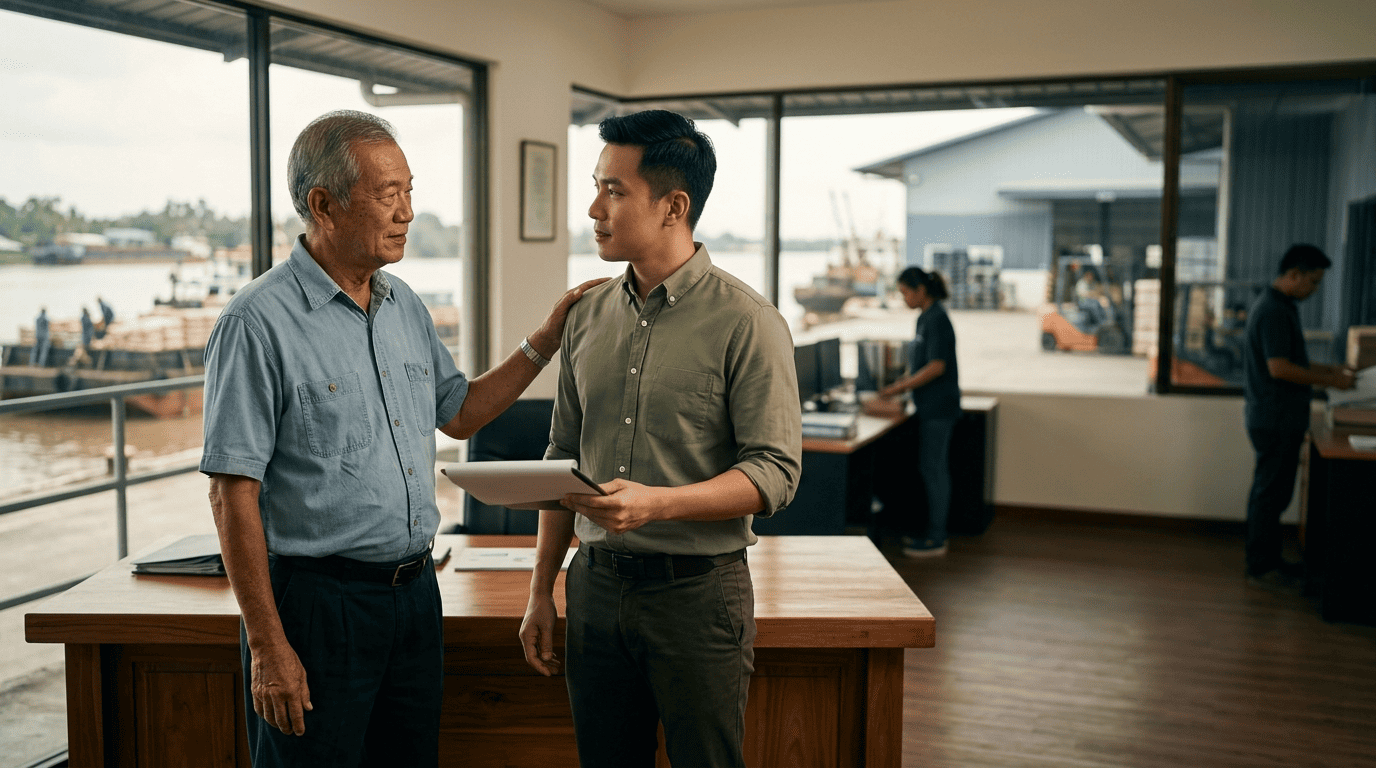
A job becomes
an institution
When we are finished, the business produces consistent, auditable earnings that no longer depend on any single person — not the founder, not us, not any individual employee. Monthly management accounts are produced. Systems run without being watched. The business exists independently of whoever started it. That is the conversion from SDE to EBITDA. That is where institutional value is found.
- Clean, auditable financials — monthly management accounts as standard
- Owner-independent operations — no key-person risk
- Documented systems that survive any individual's departure
- A business valued on earnings multiple, not personal goodwill
- The foundation for further growth, additional capital, or a structured exit

The Rajang economy is built
one business at a time.
We are not financial engineers. We are operators who believe that the most durable value is created by people who are present — in the community, in the business, and in the work. The Pre-SDE to EBITDA journey cannot be done from a distance. It takes proximity, patience, and trust.
If you own a business
in the Rajang corridor
Not ready to talk yet? Start with the valuation tool — enter your numbers and see what your business could be worth. When you're ready, we're here for an honest, unhurried conversation.
Disclaimer, Legal Status
& Regulatory Position
This page sets out the regulatory status of Eastern Rajang Capital, the legal basis on which we engage with partners and business owners, and the limitations that apply to information provided through this website and through our private communications.
Eastern Rajang Capital is a privately held acquisition entity operating a search fund mandate focused on the acquisition and operational development of micro-SMEs in the Rajang corridor, Sarawak, Malaysia.
We are not a fund manager, licensed capital market intermediary, registered investment adviser, collective investment scheme, or deposit-taking institution. We do not hold, and are not required to hold, any licence or authorization from Bank Negara Malaysia (BNM) or the Securities Commission Malaysia (SC) in relation to our acquisition activities.
Where Eastern Rajang Capital engages with co-investors or strategic partners, such engagement is conducted under the Sophisticated Investor exemptions provided by the Capital Markets and Services Act 2007 (Malaysia). Specifically, we rely on Schedule 6 (Sophisticated Investor) and Schedule 7 (High Net Worth) exemptions, which permit private placement of securities and co-investment arrangements without the requirement for a prospectus or SC registration.
All prospective co-investors are required to self-attest to their status as Sophisticated Investors prior to receiving any deal flow information, mandate documentation, or co-investment terms. Eastern Rajang Capital does not verify the accuracy of these attestations but reserves the right to decline access to any party whose stated capacity is inconsistent with the criteria. Any person who provides a false or misleading attestation bears sole legal responsibility for such misrepresentation and its consequences, including any liability arising under the Capital Markets and Services Act 2007 and applicable Malaysian law.
Prospective co-investors should be aware that participation in any co-investment arrangement facilitated by Eastern Rajang Capital involves significant risks, including but not limited to the following:
- Illiquidity. Interests in deal-specific Special Purpose Vehicles (SPVs) are not listed on any stock exchange and cannot be freely transferred or sold. Co-investors should expect to hold their interests until the relevant business is sold, recapitalised, or otherwise realised, which may take several years or may not occur at all within any anticipated timeframe.
- No secondary market. There is no established secondary market for interests in ERC-associated SPVs. Co-investors wishing to exit prior to a formal realisation event may be unable to find a buyer, and any transfer is subject to the consent provisions of the relevant SPV agreement.
- Risk of total capital loss. Investment in micro-SME acquisitions involves substantial operational and commercial risk. The acquired business may fail to perform as anticipated, may deteriorate in value, or may become insolvent. Co-investors must be prepared to sustain a total loss of their invested capital.
- Minority shareholder limitations. Co-investors will typically hold minority interests in SPVs. As minority shareholders, co-investors will have limited ability to influence management decisions, the timing or terms of any exit, or the day-to-day operational strategy of the acquired business. Decisions will be made by the manager or majority shareholder in accordance with the SPV agreement.
This website is provided for general informational purposes only. Nothing on this website constitutes:
- An offer or solicitation to subscribe for, purchase, or sell any security or investment product
- Financial, legal, tax, or investment advice of any kind
- A prospectus, information memorandum, or offering document
- A public offering of any security in Malaysia or any other jurisdiction
The information on this website is subject to change without notice. Eastern Rajang Capital makes no representations or warranties as to the accuracy, completeness, or currency of any information provided.
The acquisition of operating businesses (as distinct from securities or financial instruments) does not require licensing under the Financial Services Act 2013 or the Capital Markets and Services Act 2007, provided the activity is conducted privately and does not involve a public offering, deposit-taking, or the management of a collective investment scheme on behalf of third parties.
Eastern Rajang Capital's mandate is the direct acquisition and operational management of SMEs. We are not a fund manager. We do not hold client money. We do not offer regulated financial products. Our co-investment arrangements are bilateral private agreements, not interests in a regulated fund.
Where co-investment is structured through deal-specific Special Purpose Vehicles (SPVs), each co-investor will receive full documentation — including the co-investment structure, rights, and terms — prior to any capital commitment. The SI exemption relied upon at the website level applies equally to each SPV engagement, and attestation records are maintained accordingly.
All information provided by business owners, deal intermediaries, and prospective partners through this website or through private correspondence is treated as strictly confidential. Eastern Rajang Capital does not disclose the identity of enquirers or the nature of specific business discussions to any third party without explicit written consent.
Prospective acquirees and intermediaries may request a Non-Disclosure Agreement (NDA) prior to sharing any commercially sensitive information. We accept and operate under NDAs as a standard practice in our acquisition process.
Eastern Rajang Capital collects personal data (including name, contact information, and financial capacity declarations) from individuals who engage through this website. All personal data is collected and processed in accordance with the Personal Data Protection Act 2010 (Malaysia).
Data collected through this website is used solely for the purpose of processing partner access requests, verifying Sophisticated Investor attestations, and conducting acquisition-related correspondence. We do not sell, rent, or share personal data with third parties without explicit written consent, except where required by law.
For any queries relating to the regulatory status, legal basis of engagement, or compliance matters applicable to Eastern Rajang Capital's activities, please contact us directly at rk@easternrajang.my.
Partner access requests and Sophisticated Investor declarations are initiated via direct email enquiry to rk@easternrajang.my. We respond to all compliance-related enquiries within five business days.
Privacy Policy
Eastern Rajang Capital · Majetika Ventures (SSM Reg: 202503305428)
Last updated: June 2026
Eastern Rajang Capital is a private acquisition mandate operated by Majetika Ventures (SSM Reg: 202503305428), Rajang Corridor, Sarawak, Malaysia. This policy explains how we collect, use, and protect personal data submitted through this website (easternrajang.my).
Our data contact is Raphael Kassim — rk@easternrajang.my.
We collect the following personal data through this website:
- Via the Sophisticated Investor attestation modal: full name, email address, declaration timestamp, IP address, browser and device information, and a generated reference ID.
- Via the contact form: full name, phone number, email address (optional), business description, and referral source.
- Via automated systems: IP address, browser type, operating system, and country (logged by EmailJS as part of email delivery processing).
- Attestation data is collected to maintain a record of Sophisticated Investor self-declarations as required under Schedules 6 & 7 of the Capital Markets and Services Act 2007 (Malaysia).
- Contact form data is collected to respond to your enquiry and to determine whether an acquisition conversation is appropriate.
- We do not use your data for marketing, profiling, or any purpose beyond the above.
- Attestation records are retained for a minimum of 7 years in accordance with CMSA 2007 requirements.
- Contact form submissions are delivered via Web3Forms to rk@easternrajang.my and retained in email records.
- Attestation confirmation emails are processed and delivered via EmailJS (emailjs.com). EmailJS logs basic delivery metadata including IP address and browser information as part of its service.
- We do not operate a database or CRM. All records are held in email and secure document storage accessible only to Raphael Kassim.
We do not sell, rent, or share your personal data with any third party for commercial purposes. The following third-party services process data on our behalf as data processors:
- EmailJS (emailjs.com) — email delivery for attestation confirmations.
- Web3Forms (web3forms.com) — contact form submission processing.
Both services operate under their own privacy policies. We have no control over their internal data handling beyond what is described in their respective policies.
Under the Personal Data Protection Act 2010 (Malaysia), you have the right to:
- Request access to personal data we hold about you.
- Request correction of inaccurate personal data.
- Request that we cease processing your data for direct marketing (we do not conduct direct marketing).
- Withdraw consent for data processing, subject to legal and regulatory retention requirements.
Eastern Rajang Capital will only ever contact you from rk@easternrajang.my or easternrajang.notifications@gmail.com (automated confirmations only). We have no representatives or agents.
We may update this policy from time to time. The current version is always available at easternrajang.my. The date of last update is shown at the top of this page. Continued use of this website following any update constitutes acceptance of the revised policy.
For all data protection enquiries: rk@easternrajang.my · Majetika Ventures, Rajang Corridor, Sarawak, Malaysia.
Eastern Rajang Capital is a private search fund and acquisition vehicle mandate operated by Majetika Ventures SSM Reg No. 202503305428 . We are not licensed by Bank Negara Malaysia (BNM) or the Securities Commission Malaysia (SC). We are an operational acquisition firm, not a licensed fund manager, investment adviser, We do not offer investment products to the public, manage third-party funds, or conduct deposit-taking activities. Acquisitions are typically executed through deal-specific Special Purpose Vehicles (SPVs) to ensure operational ring-fencing.
Private Acquisition Mandate — Sophisticated Investor Basis (CMSA 2007 Sch. 6 & 7) Not a Licensed Fund Manager or Investment AdviserIn accordance with Schedules 6 & 7 of the CMSA 2007, engagement regarding co-investment is restricted to Sophisticated Investors only. This website is a digital brochure for a private search mandate and does not constitute a "public offering," "prospectus," or "invitation to subscribe" to securities. Access to deal flow is restricted to attested Sophisticated Investors only. This website does not constitute a public offering of securities.
Information on this website is for general informational purposes only and does not constitute financial advice, a solicitation to invest, or an offer of securities. Projected EBITDA growth figures are illustrative only and do not represent guaranteed returns. Past performance of acquired businesses does not predict future outcomes.
Acquisition entrepreneurship involves significant operational risk. Projected EBITDA growth is based on our proprietary SDE-to-EBITDA methodology and does not represent guaranteed future performance. ERC/Majetika Ventures does not provide financial, legal, or tax advice. Projected operational improvements and EBITDA growth metrics are illustrative estimates based on our operational methodology and do not constitute a guarantee of returns. Eastern Rajang Capital reference number for internal record-keeping: ERC-MY-2026.